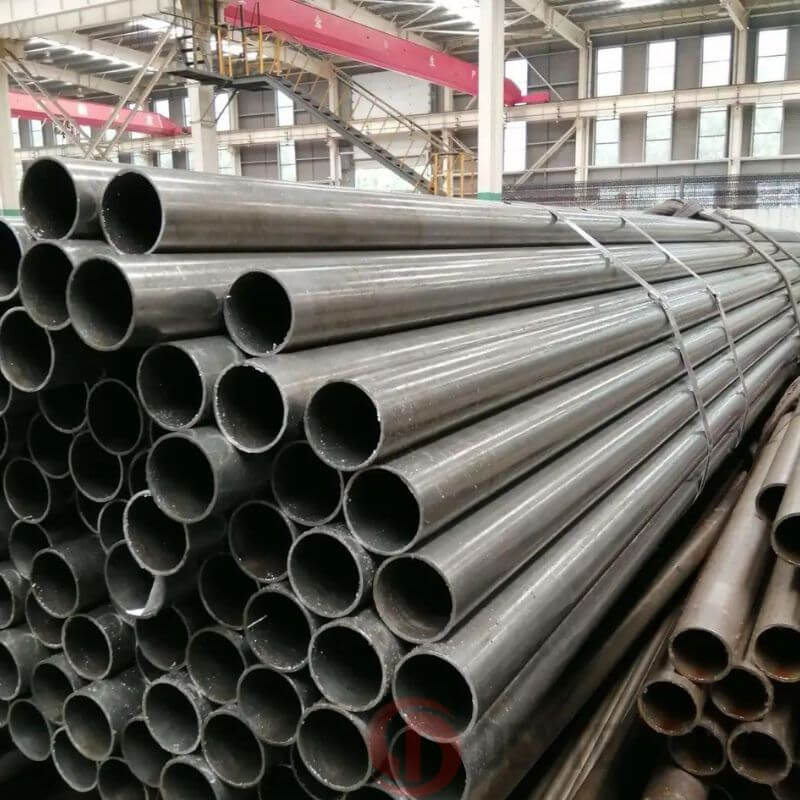
Cold drawn seamless tubing is valued primarily for its tight dimensional tolerances. The cold drawing process significantly improves control of both outer diameter and inner diameter compared with hot finished tubes.
Another important characteristic is the superior surface finish achieved through cold working. This smoother surface improves machinability and reduces the amount of finishing work required during component manufacturing.
Cold drawing also improves concentricity and wall thickness uniformity. These qualities are especially important for hydraulic cylinders and precision mechanical parts where uneven wall thickness can affect performance.
However, the cold drawing process can introduce higher residual stresses in the material compared with hot finished tubing, which may influence certain forming operations.
| Comparison Dimension | Cold Drawn Seamless Tubing (CDS) | Hot Finished Seamless Tubing (HFS) | Drawn Over Mandrel Tubing (DOM) |
|---|---|---|---|
| Dimensional Accuracy | Very tight OD and ID tolerances | Moderate dimensional control | Tight tolerances similar to CDS |
| Surface Finish | Smooth precision surface | Rougher mill finish | Excellent smooth internal surface |
| Concentricity | Very good concentricity | Less precise | Excellent concentricity |
| Typical Applications | Hydraulic cylinders, precision machining | High temperature piping, structural use | Automotive components, mechanical tubing |
Value Added Sevices
Hydraulic cylinder manufacturers require CDS to perform as a precision component. To achieve this, the raw tube must be cut to exact lengths and machined to accept end caps and port fittings, ensuring leak-free operation under high pressure.
Frequently Asked Questions
Manufacturers using Cold Drawn Seamless tubing typically operate high-precision machining processes where dimensional accuracy and surface finish directly influence product performance. Their questions therefore focus on tolerance control, machinability, and suitability for hydraulic applications. The following topics reflect the most common technical concerns encountered during procurement.
What makes CDS tubing different from standard seamless tubing?
CDS tubing undergoes an additional cold drawing process after the initial seamless tube production. This process improves dimensional accuracy, surface finish, and concentricity compared with hot finished tubing.
Why is CDS tubing commonly used for hydraulic cylinders?
Hydraulic systems require precise internal diameters and smooth surfaces to ensure proper sealing and piston movement. CDS tubing provides the accuracy and machinability needed for honing and precision finishing.
Can CDS tubing be easily machined?
Yes. The cold drawing process produces consistent hardness and refined grain structure, allowing CDS tubing to machine cleanly. This makes it suitable for components that require drilling, boring, or threading.
What tolerance levels can CDS tubing achieve?
CDS tubing typically offers much tighter OD and ID tolerances than hot finished tubes. These tight tolerances reduce the amount of material removal required during machining operations.
Is CDS tubing suitable for high-pressure applications?
Yes. CDS tubing is commonly used in hydraulic and mechanical systems where pressure resistance and dimensional consistency are critical. Engineers select appropriate wall thickness and material grades based on system pressure requirements.
CDS tubing undergoes an additional cold drawing process after the initial seamless tube production. This process improves dimensional accuracy, surface finish, and concentricity compared with hot finished tubing.
Hydraulic systems require precise internal diameters and smooth surfaces to ensure proper sealing and piston movement. CDS tubing provides the accuracy and machinability needed for honing and precision finishing.
Yes. The cold drawing process produces consistent hardness and refined grain structure, allowing CDS tubing to machine cleanly. This makes it suitable for components that require drilling, boring, or threading.
CDS tubing typically offers much tighter OD and ID tolerances than hot finished tubes. These tight tolerances reduce the amount of material removal required during machining operations.
Yes. CDS tubing is commonly used in hydraulic and mechanical systems where pressure resistance and dimensional consistency are critical. Engineers select appropriate wall thickness and material grades based on system pressure requirements.
Related Glossaries
A manufacturing process where a seamless tube is pulled through a die at room temperature to reduce its diameter and improve dimensional accuracy. The process refines the steel grain structure and produces tighter tolerances and smoother surfaces.
A finishing process used to produce a very smooth internal surface inside tubes. Honing is commonly applied to CDS tubing used for hydraulic cylinders to ensure proper sealing and smooth piston movement.
Steel tubing produced primarily for structural or mechanical components rather than fluid transport. Mechanical tubing typically requires tighter dimensional tolerances and better surface finish than standard pipe.
The acceptable variation in tube wall thickness along its length. Tight control of wall thickness ensures predictable mechanical strength and consistent machining results.
A manufacturing process where a seamless tube is pulled through a die at room temperature to reduce its diameter and improve dimensional accuracy. The process refines the steel grain structure and produces tighter tolerances and smoother surfaces.
A finishing process used to produce a very smooth internal surface inside tubes. Honing is commonly applied to CDS tubing used for hydraulic cylinders to ensure proper sealing and smooth piston movement.
Steel tubing produced primarily for structural or mechanical components rather than fluid transport. Mechanical tubing typically requires tighter dimensional tolerances and better surface finish than standard pipe.
The acceptable variation in tube wall thickness along its length. Tight control of wall thickness ensures predictable mechanical strength and consistent machining results.