Technical Clarification
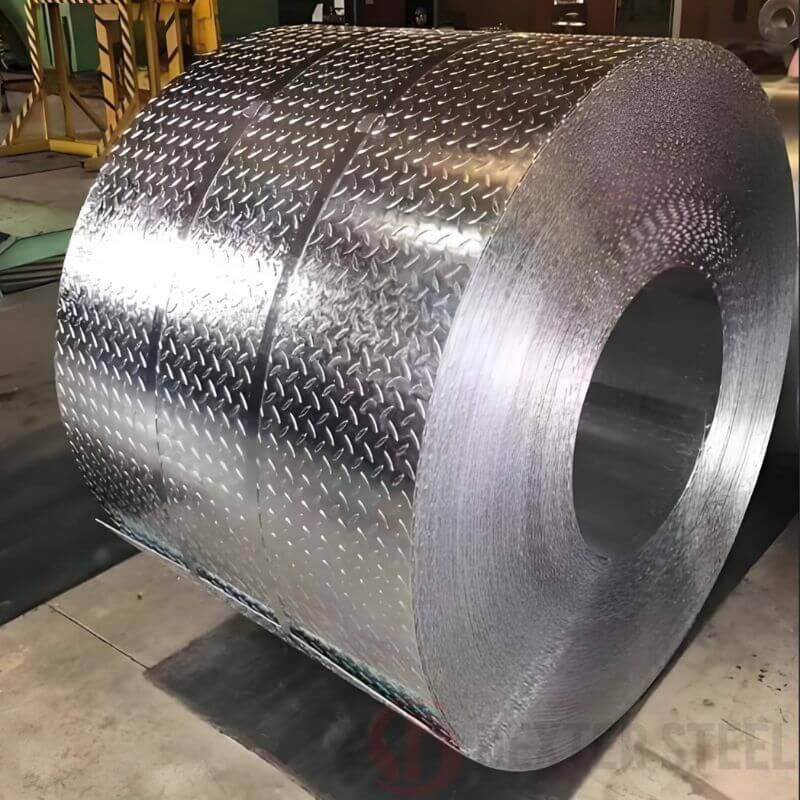
Embossing is a surface-forming process and does not alter the base material grade, chemical composition, or fundamental mechanical properties of the underlying steel. The structural strength and corrosion resistance remain determined by the original substrate (cold rolled, galvanized, stainless, or prepainted steel).
Typical embossed pattern depth ranges from approximately 0.1 mm to 0.6 mm, depending on design requirements and base thickness. Deeper patterns may increase surface rigidity but must be matched appropriately to substrate thickness to avoid distortion during forming.
For thickness measurement and tolerance control, industry practice measures the base steel thickness before embossing. The embossed height variation is not included in nominal thickness specification unless otherwise agreed. Thickness tolerance remains governed by the original base material standard (e.g., ASTM, EN, JIS), while pattern depth is controlled separately as a forming parameter.
Frequently Asked Questions
The following questions reflect the most common concerns from manufacturers using embossed steel in visible or decorative components. These buyers typically focus on pattern consistency, forming compatibility, and surface protection during processing.
What base materials can be used for embossed steel coil?
Embossing can be applied to cold rolled, galvanized, stainless steel, or prepainted substrates, depending on corrosion and aesthetic requirements.
Does embossing affect mechanical strength?
Embossing can increase surface rigidity slightly, but overall structural strength depends primarily on the base material thickness and grade.
Can embossed steel be roll formed or bent?
Yes, provided appropriate forming parameters are used. Pattern depth and base thickness should be considered when determining bend radius.
Is custom pattern development possible?
Yes. Custom roller molds can be developed for specific pattern designs, subject to minimum order requirements.
How is surface damage prevented during shipping?
Protective film application and reinforced packaging are used to prevent scratches and pattern deformation during handling and transport.
Embossing can be applied to cold rolled, galvanized, stainless steel, or prepainted substrates, depending on corrosion and aesthetic requirements.
Embossing can increase surface rigidity slightly, but overall structural strength depends primarily on the base material thickness and grade.
Yes, provided appropriate forming parameters are used. Pattern depth and base thickness should be considered when determining bend radius.
Yes. Custom roller molds can be developed for specific pattern designs, subject to minimum order requirements.
Protective film application and reinforced packaging are used to prevent scratches and pattern deformation during handling and transport.
Related Glossaries
A mechanical forming method where patterned rollers press texture onto steel surface to create raised or recessed designs.
An embossed pattern designed to improve friction and reduce slipping in flooring or equipment applications.
The patterned roller used during embossing. Pattern precision depends on mold quality and wear condition.
A mechanical forming method where patterned rollers press texture onto steel surface to create raised or recessed designs.
An embossed pattern designed to improve friction and reduce slipping in flooring or equipment applications.
The patterned roller used during embossing. Pattern precision depends on mold quality and wear condition.