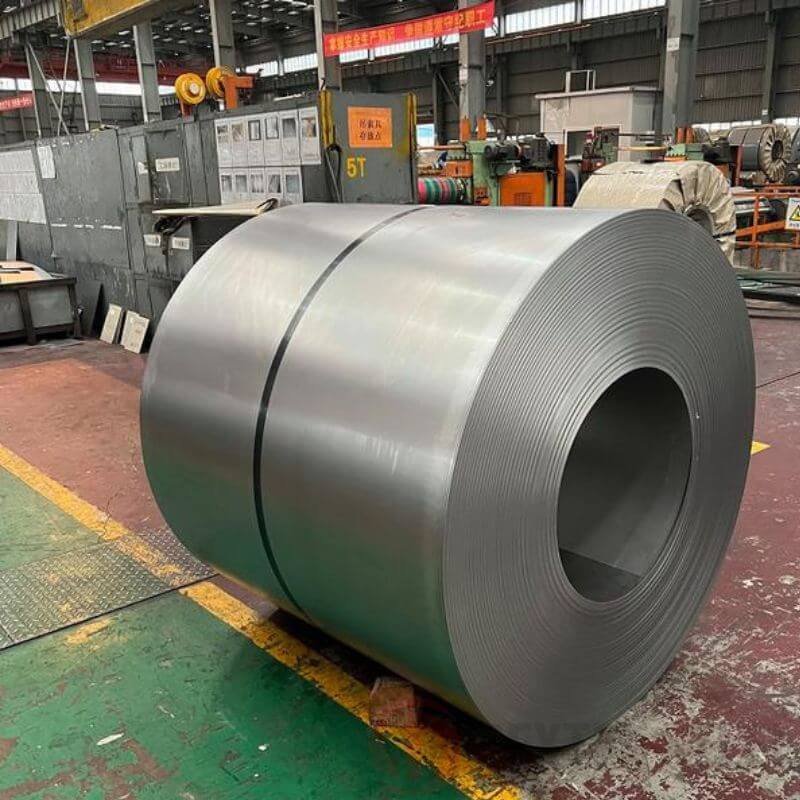
Material Grades
ASTM A572 Grade 50
Widely used structural HSLA grade offering 345 MPa minimum yield strength. Common in bridges, frames, and heavy equipment.
EN S355MC
Thermo-mechanically rolled HSLA grade suitable for cold forming and welded structures.
JIS SAPH440
Japanese HSLA equivalent used in automotive and structural fabrication sectors.
GB Q355B
Chinese HSLA structural grade widely used for export projects requiring balanced strength and weldability.
Characteristics
HSLA Steel Coil is primarily differentiated by its enhanced yield strength achieved through microalloying elements such as niobium, vanadium, or titanium. This allows thinner sections to achieve similar load-bearing capacity compared to conventional carbon steel.
Weldability remains stable due to controlled carbon content. Unlike high-carbon steels, HSLA maintains a good balance between strength and fabrication practicality.
Formability depends on grade selection. Some HSLA grades are optimized for structural strength, while others are designed for improved forming performance in stamped components.
| Comparison | HSLA Steel Coil | Weathering Steel Coil | Hot Rolled Steel Coil (HRC) | Cold Rolled Steel Coil (CRC) | Hot Rolled Pickled & Oiled (HRPO) |
|---|---|---|---|---|---|
| Primary Design Focus | High strength-to-weight ratio and structural performance | Atmospheric corrosion resistance for outdoor exposure | General-purpose structural and forming applications | Dimensional precision and surface quality | Surface cleanliness improvement after hot rolling |
| Surface Condition | Hot rolled surface unless further processed | Hot rolled surface; forms protective oxide layer over time | Mill scale present | Smooth, clean, and tighter tolerance surface | Pickled to remove mill scale; lightly oiled for protection |
| Typical Application Priority | Load-bearing structures, chassis, heavy equipment | Bridges, outdoor structures, exposed steelwork | General fabrication and structural components | Precision stamping, appliance panels, formed parts | Parts requiring cleaner surface for forming or painting |
Frequently Asked Questions
Common technical concerns from structural manufacturers and fabrication workshops. These buyers typically focus on yield strength consistency, weldability, and whether HSLA can reliably replace conventional carbon steel without introducing forming or cracking risks.
Can HSLA steel replace standard carbon steel directly?
In many cases, yes. However, section thickness and design calculations must be reviewed. HSLA allows strength improvement, but forming and weld parameters may need minor adjustment.
Is HSLA steel more difficult to weld?
HSLA generally maintains good weldability, but higher strength grades may require controlled heat input and appropriate filler materials to avoid heat-affected zone softening or cracking.
Does higher strength mean lower formability?
Higher yield strength can reduce elongation slightly. Proper grade selection and bend radius control are important for parts requiring tight forming.
How stable are mechanical properties between batches?
Mechanical properties are controlled within standard tolerance ranges. Mill test certificates confirm yield strength, tensile strength, and elongation for each batch.
Is HSLA suitable for cold forming applications?
Yes, provided the grade is selected correctly. Some HSLA grades are specifically optimized for forming while maintaining higher structural strength.
In many cases, yes. However, section thickness and design calculations must be reviewed. HSLA allows strength improvement, but forming and weld parameters may need minor adjustment.
HSLA generally maintains good weldability, but higher strength grades may require controlled heat input and appropriate filler materials to avoid heat-affected zone softening or cracking.
Higher yield strength can reduce elongation slightly. Proper grade selection and bend radius control are important for parts requiring tight forming.
Mechanical properties are controlled within standard tolerance ranges. Mill test certificates confirm yield strength, tensile strength, and elongation for each batch.
Yes, provided the grade is selected correctly. Some HSLA grades are specifically optimized for forming while maintaining higher structural strength.