
Precision Steel Drilling for global Projects
Ensure perfect fit-up and accelerate your project timeline with Dexter Steel’s precision drilling services
Fabrication Services
-
Bending
-
Pipe Beveling
-
Bolted Connection
-
Cambering
-
Cutting
-
Drilling
-
Galvanization
-
Punching
-
Riveting
-
Slitting
-
Slotting
-
Tapping
-
Welding
Precision Drilling Capability
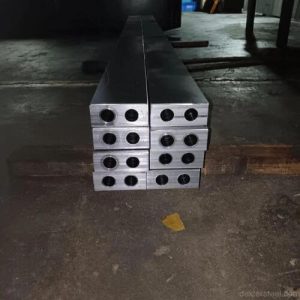
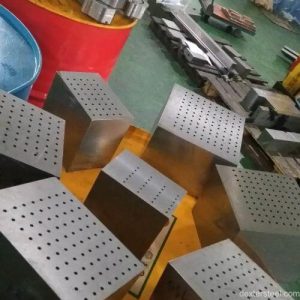
We deliver accurately drilled beams, plates, and components, ready for fast and secure bolted assembly on-site. Our expertise eliminates costly field rework and ensures every connection meets design specifications. From a single template to complex multi-piece assemblies, trust us for holes that fit. Upload your drawings for a fast and accurate quote.
Quality-Drill Steel
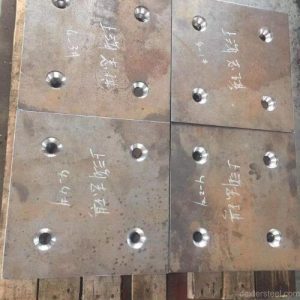
We utilize advanced CNC drilling machines and multi-head gantry drills to achieve exceptional precision and consistency. Our machinery handles a wide range of sections, from light angles to heavy beams, with hole tolerances consistently within **±0.5 mm**. We routinely process high-strength steels like **ASTM A572 Gr. 50** and **AR400** abrasion-resistant plate, using specialized carbide tooling and optimized feed rates to ensure clean, burr-free holes with no work hardening. This capability is crucial for producing reliable connection kits for projects.
Project Portfolio
Related Industry Terms
Drilling performed by a Computer Numerical Control machine, which automates the process for extreme accuracy, repeatability, and efficiency, especially for complex patterns or high volumes.
The permissible limit of variation in a hole’s diameter. We typically hold a tight tolerance of ±0.5 mm to ensure bolts fit as intended, preventing slop or fit-up issues.
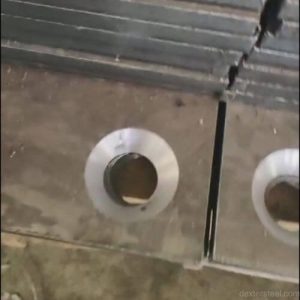
A rough edge or ridge of material left on the workpiece after a drilling operation. We employ deburring techniques to remove this, ensuring safe handling and proper bolt bearing.
A drilling technique where the drill bit is periodically withdrawn to clear chips from the hole. This is essential for drilling deep holes or in stringy materials to prevent bit breakage.
The process of drilling a pilot hole to a specific size before tapping (cutting internal threads). The size is critical to achieving the correct thread depth and strength.
Drilling performed by a Computer Numerical Control machine, which automates the process for extreme accuracy, repeatability, and efficiency, especially for complex patterns or high volumes.
The permissible limit of variation in a hole’s diameter. We typically hold a tight tolerance of ±0.5 mm to ensure bolts fit as intended, preventing slop or fit-up issues.
A rough edge or ridge of material left on the workpiece after a drilling operation. We employ deburring techniques to remove this, ensuring safe handling and proper bolt bearing.
A drilling technique where the drill bit is periodically withdrawn to clear chips from the hole. This is essential for drilling deep holes or in stringy materials to prevent bit breakage.
The process of drilling a pilot hole to a specific size before tapping (cutting internal threads). The size is critical to achieving the correct thread depth and strength.
Frequently Asked Questions
What is your standard tolerance for drilled holes?
Our standard tolerance is ±0.5 mm on hole diameter and ±1.0 mm on true position, which meets or exceeds the requirements of AISC, AS, and EN standards.
Can you drill hardened steel like AR400?
Yes. We use specialized carbide drill bits and rigid CNC machinery to successfully drill hard steels like AR400 and AR500, maintaining hole quality and tool life.
Do you offer deburring as part of the service?
Absolutely. Deburring is a standard part of our quality control process. All drilled holes are deburred to ensure safety and proper fit for bolts and connectors.
What file formats do you accept for custom drilling patterns?
We accept all common file formats, including .DXF, .DWG, and .PDF. Our engineering team can also work from a detailed sketch with dimensions.
Our standard tolerance is ±0.5 mm on hole diameter and ±1.0 mm on true position, which meets or exceeds the requirements of AISC, AS, and EN standards.
Yes. We use specialized carbide drill bits and rigid CNC machinery to successfully drill hard steels like AR400 and AR500, maintaining hole quality and tool life.
Absolutely. Deburring is a standard part of our quality control process. All drilled holes are deburred to ensure safety and proper fit for bolts and connectors.
We accept all common file formats, including .DXF, .DWG, and .PDF. Our engineering team can also work from a detailed sketch with dimensions.