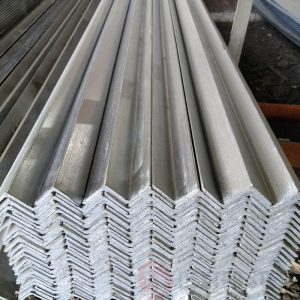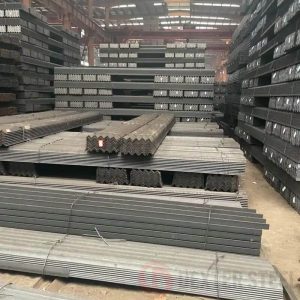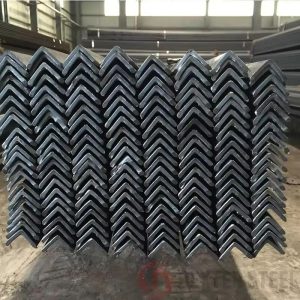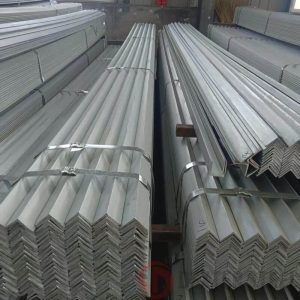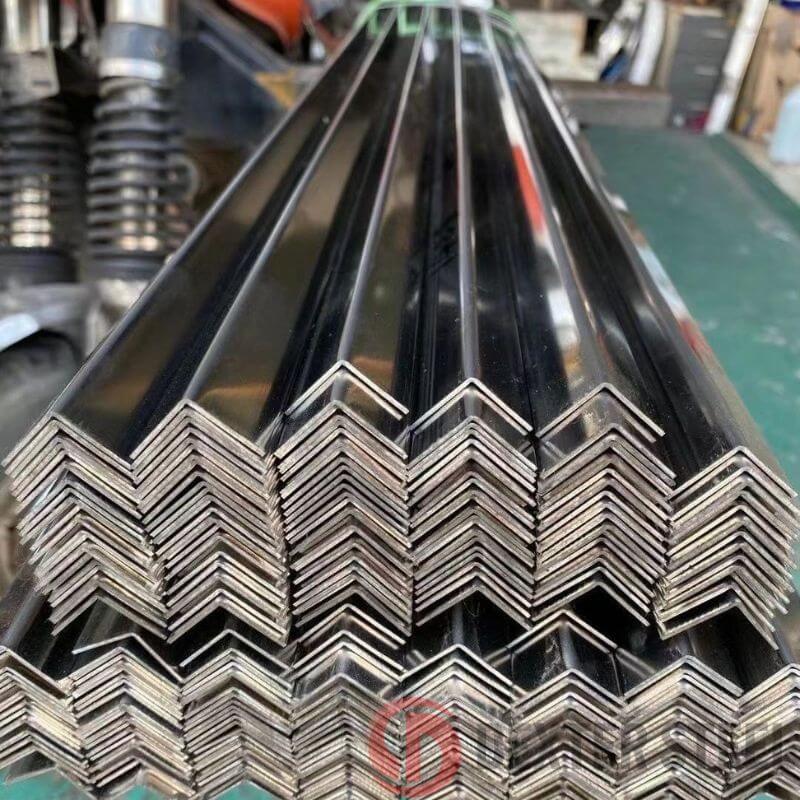
Key Characteristics & Comparison
Stainless steel angle’s corrosion resistance comes from a minimum 10.5% chromium, which forms a self-repairing passive oxide film. Nickel additions stabilize the austenitic structure, improving formability and toughness.
Its non-porous surface resists bacterial colonization and withstands aggressive sanitizers, making it essential for hygienic environments like food and pharmaceutical facilities subject to regulatory inspection.
Aesthetic appeal drives architectural use. The natural silver finish runs through the entire thickness, resisting fading or peeling. Surface options range from industrial matte to mirror polish.
High-temperature performance suits process equipment and exhaust systems. Austenitic grades maintain strength at elevated temperatures and resist scaling where carbon steel would rapidly oxidize or lose structural capacity.
Comparison Table
| Dimension | Stainless Steel Angle | Weathering Steel Angle | Galvanized Steel Angle |
|---|---|---|---|
| Corrosion Mechanism | Passive chromium oxide layer provides inherent, through-thickness corrosion resistance. Self-repairs if damaged when exposed to oxygen. | Forms stable patina through controlled oxidation that protects underlying metal when exposed to atmospheric cycling. | Sacrificial zinc coating provides barrier and galvanic protection. Corrosion resistance is dependent on coating integrity and thickness. |
| Maintenance Requirements | Minimal to none. Occasional cleaning to remove surface contaminants may be performed for appearance or hygiene. | None required for the patina to develop and perform. However, design details must allow for drainage to prevent prolonged moisture contact. | Zinc coating eventually degrades. Lifespan depends on coating thickness and environment; touch-up may be required at cut edges and welds. |
| Suitability for Exposed Installations | Excellent for all environments, including marine, industrial, and architectural. Grade selection based on specific corrosivity. | Suitable for most atmospheric exposures but not recommended for marine spray zones, continuous immersion, or buried applications. | Suitable for general outdoor use, freshwater exposure, and many industrial atmospheres. Not recommended for strong acids or alkalis. |
| Aesthetic Appearance | Natural metallic luster maintained with optional polished finishes. Color consistent and will not change significantly over time. | Develops distinctive rust-brown patina that stabilizes over 1-3 years. Appearance is integral to design for architectural applications. | Bright spangled appearance initially, weathering to dull gray. Appearance can be specified as spangled or minimized spangle. |
Value Added Sevices
Stainless steel angle serves hygienic and corrosive environments in food processing, pharmaceutical, and marine applications. Processing requires specialized techniques to maintain corrosion resistance and achieve sanitary finish requirements.
Frequently Asked Questions
Buyers regularly ask about the practical differences between common grades, how fabrication affects corrosion resistance, and what surface finish options are available for visible installations. These questions reflect the need to balance performance, cost, and appearance.
What is the difference between 304 and 316 stainless steel angle?
304 is the general-purpose grade with excellent corrosion resistance for food, dairy, and atmospheric exposures. 316 contains molybdenum for enhanced resistance to chlorides and industrial chemicals, making it the preferred choice for marine environments, road de-icing salt exposure, and chemical processing applications.
Can stainless steel angle be welded without losing corrosion resistance?
Yes, but proper procedures must be followed. The heat-affected zone can become sensitized if carbon content is too high or cooling is too slow, leading to intergranular corrosion. Using low-carbon grades like 304L or 316L, or stabilized grades, maintains corrosion resistance after welding. Post-weld cleaning and passivation restore the protective oxide layer.
Does stainless steel require any protective coating?
No, stainless steel is inherently corrosion-resistant and does not require painting or galvanizing. The passive chromium oxide layer forms naturally and self-repairs if damaged, provided the surface is clean and exposed to oxygen. This eliminates long-term maintenance coating costs.
What surface finishes are available for architectural applications?
Standard mill finish (No. 1) is suitable for industrial use. For visible applications, we offer No. 2B (cold rolled, smooth), No. 4 (brushed), and BA (bright annealed) finishes. Polishing to specific grit requirements is available through our processing services to match architectural specifications.
Is stainless steel angle magnetic?
Austenitic grades like 304 and 316 are generally non-magnetic in the annealed condition. However, cold working during processing or fabrication can induce some magnetism. Ferritic and martensitic stainless grades are magnetic but are less common in angle form.
304 is the general-purpose grade with excellent corrosion resistance for food, dairy, and atmospheric exposures. 316 contains molybdenum for enhanced resistance to chlorides and industrial chemicals, making it the preferred choice for marine environments, road de-icing salt exposure, and chemical processing applications.
Yes, but proper procedures must be followed. The heat-affected zone can become sensitized if carbon content is too high or cooling is too slow, leading to intergranular corrosion. Using low-carbon grades like 304L or 316L, or stabilized grades, maintains corrosion resistance after welding. Post-weld cleaning and passivation restore the protective oxide layer.
No, stainless steel is inherently corrosion-resistant and does not require painting or galvanizing. The passive chromium oxide layer forms naturally and self-repairs if damaged, provided the surface is clean and exposed to oxygen. This eliminates long-term maintenance coating costs.
Standard mill finish (No. 1) is suitable for industrial use. For visible applications, we offer No. 2B (cold rolled, smooth), No. 4 (brushed), and BA (bright annealed) finishes. Polishing to specific grit requirements is available through our processing services to match architectural specifications.
Austenitic grades like 304 and 316 are generally non-magnetic in the annealed condition. However, cold working during processing or fabrication can induce some magnetism. Ferritic and martensitic stainless grades are magnetic but are less common in angle form.
Material Grades
304/L
the most widely used austenitic grade. 304 offers good corrosion resistance for food and architectural applications. 304L has lower carbon content to maintain corrosion resistance after welding without requiring post-weld heat treatment.
316/L
316/L stainless steel contains 2-3% molybdenum for enhanced resistance to chlorides and industrial chemicals. 316L is the low-carbon version preferred for welded fabrication. Standard grade for marine and chemical processing applications.
321
321 stainless steel is stabilized with titanium to prevent sensitization during elevated temperature service. Used for exhaust systems, expansion joints, and applications involving intermittent heating between 800-1500°F.
Duplex 2205
Duplex 2205 offers nearly double the yield strength of austenitic grades with excellent chloride stress corrosion cracking resistance. Used in chemical tankers, desalination plants, and structural applications requiring high strength and corrosion resistance.
Industries Served
Stainless steel angle transforms into finished products requiring corrosion resistance, hygienic surfaces, and aesthetic appeal. Fabricators in food, pharmaceutical, chemical, and architectural sectors rely on stainless angles for durable, long-lasting installations that maintain appearance and cleanliness throughout their service life.
Food and Beverage
- Processing equipment frames
- Vessel support stands
- Cutting table frames
Pharmaceutical
- Laboratory furniture frames
- Sterile equipment stands
- Equipment mounting frames
Marine
- Boat lift frames
- Dock support structures
- Shipboard handrails