Frequently Asked Questions
Weathering steel plate buyers often focus on corrosion performance, environmental suitability, and long-term maintenance expectations. Infrastructure contractors and architects need to understand how the protective patina forms and under what conditions the material performs best.
What makes weathering steel plate resistant to atmospheric corrosion?
Weathering steel contains alloying elements such as copper, chromium, and nickel that promote the formation of a dense oxide layer on the surface. This layer adheres tightly to the steel and slows down further corrosion when exposed to the atmosphere.
Does weathering steel plate require painting or coating?
In many outdoor structural applications, weathering steel can be used without paint because the protective patina provides corrosion resistance. However, coatings may still be applied in environments where appearance or additional protection is required.
Can weathering steel plate be used in all outdoor environments?
Weathering steel performs best in environments with alternating wet and dry exposure. It is generally not recommended for continuously wet conditions, marine immersion, or environments with high chloride concentrations where the protective patina may not stabilize.
How long does it take for the protective patina to develop?
The patina typically begins forming within several months of atmospheric exposure. The full protective layer may take one to three years to stabilize depending on climate, humidity, and environmental conditions.
Is weathering steel plate suitable for architectural applications?
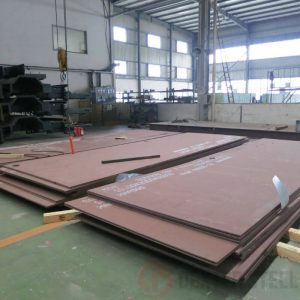
Yes. Many architectural designers use weathering steel because the natural patina creates a distinctive rust-colored surface appearance while also providing corrosion protection, reducing long-term maintenance requirements for outdoor structures.
Weathering steel contains alloying elements such as copper, chromium, and nickel that promote the formation of a dense oxide layer on the surface. This layer adheres tightly to the steel and slows down further corrosion when exposed to the atmosphere.
In many outdoor structural applications, weathering steel can be used without paint because the protective patina provides corrosion resistance. However, coatings may still be applied in environments where appearance or additional protection is required.
Weathering steel performs best in environments with alternating wet and dry exposure. It is generally not recommended for continuously wet conditions, marine immersion, or environments with high chloride concentrations where the protective patina may not stabilize.
The patina typically begins forming within several months of atmospheric exposure. The full protective layer may take one to three years to stabilize depending on climate, humidity, and environmental conditions.
Yes. Many architectural designers use weathering steel because the natural patina creates a distinctive rust-colored surface appearance while also providing corrosion protection, reducing long-term maintenance requirements for outdoor structures.
Material Grades
ASTM A588
HSLA steel with 50 ksi yield, forms protective rust layer for bridges and facades.
ASTM A242
Early HSLA structural steel, better atmospheric resistance for lightweight structures and poles.
S355J0W
355 MPa yield weathering steel, good impact property for bolted/welded bridges.
Q355NH
Chinese weathering steel for welded structures needing better atmospheric corrosion resistance.
Industries Served
Develops a protective patina; ideal for uncoated, low-maintenance structures.
Transportation Infrastructure:
- AHighway and railway bridge spans
- Retaining walls and noise barrier walls
- Light poles and transmission towers
Architectural Features:
- Exterior building façades
- Landscape edging, planters, and sculptures
- Outdoor staircases and walkways
Rail & Heavy Transport:
- Railroad hopper car bodies
- Intermodal shipping container frames